
According to 2025 data gathered by the UK’s workplace health and safety regulator, Health and Safety Executive (HSE), around 2.3 million working days are lost each year in the transport and storage sector due to workplace injury and work-related illness. It’s unsurprising, then, that, for many warehousing leaders, health and safety training is near the top of their agenda – which necessitates a thorough look into HSG76, the HSE’s guidebook on warehousing and storage best practices.
As a site manager or warehouse supervisor, you’re likely already aware of the documentation, but that doesn’t make the 155-page-long guidelines any less daunting.
Fortunately, however, I’m here to offer you a refresher and walk you through the core details. As I’ve discovered in my 30 years in the materials handling sector, it’s not as complicated as you might think. Behind the veneer of regulatory complexity, HSG76 is actually very logical and understandable, provided you have a baseline of warehouse health and safety knowledge.
Before I get down to business, though, download your copy of the HG76 manual for future reference – you may wish to keep it at the ready in a separate tab.
Here’s what to expect from this guide:
- TL;DR
- What is HSG76?
- HSG76 Core Areas
- Why HSG76 Matters for Managers, Supervisors & Safety Reps
- The Bottom Line on Warehousing & Storage Safety
- Frequently Asked Questions
TL;DR
HSG76, or Warehousing and Storage: a guide to health and safety, is a guidebook written by the Health & Safety Executive in conjunction with the Warehousing Health and Safety Forum. Intended for site managers, reps and supervisors, it shares best practices for manual handling, site transport, working at height, and broader risk prevention.
What is HSG76?
Among HSE’s many duties as a regulator is to provide workplace safety guidance across sectors, with industry-specific advice foregrounded in the current legislation. HSG76 is one such piece of guidance.
Written in conjunction with specialists and union reps from the Warehousing Health and Safety Forum, it shares best practices across a broad range of occupational safety areas, from mitigating manual handling risks to safely installing racking and other storage systems.
Who is the Guide Intended For?
The HSG76 warehouse storage safety guidelines are written for anyone with health and safety interests in workplaces that involve warehousing and storage operations – be it a distribution hub, self-storage centre or busy manufacturing and engineering facility.
More specifically, employers and site owners are responsible for enforcing the techniques and methodologies outlined in the manual. Under the Health and Safety Act 1974, it’s their statutory duty to ensure the health and wellbeing of both staff and members of the public. Similarly, workers have a duty of care to protect themselves and colleagues.
Its Purpose
A common misconception of HSE guidance documents is that they’re pieces of legislation; in reality, it’s better to think of them as pragmatic advice from an experienced industry specialist. In this way, the purpose of the HSE guide to warehousing and storage is to provide a general framework for common warehousing operations that will help ensure minimum levels of compliance.
HSE’s founding mission is centred on worker protection, but it extends even further to include public assurance. As they state on their website: “We are dedicated to protecting people and places, and helping everyone lead safer and healthier lives…We work to ensure people feel safe where they live, where they work and in their environment.”
As such, following the counsel of this Governmental body is the simplest way for managers, supervisors and site owners to protect the 4 Ps of people, planet, property and profits.
HSG76 Core Areas
As I hinted at earlier, the HSG76 guidance covers extensive ground – across specific tasks, such as safely stacking pallets or operating manual handling aids like pallet trucks, and on a more holistic level, with broader emphasis on managerial responsibility, occupational health, risk management and emergency response.
Together, these elements coalesce into an effective strategic framework that will ensure legal compliance and efficiency across your organisation. This sets the foundation for a proactive safety culture enforced from the top down, especially when regularly reviewed and revised.
While I don’t have the time here to focus on the minute detail, I will summarise the core problem areas your staff should tackle, plus the appropriate corrective action/techniques that HSE recommend. Without further ado, let’s break it down.
General Health & Safety
The first portion of HSE’s warehouse storage safety guidelines is dedicated to reducing the number of injuries and cases of occupational ill health through broader preventative strategies.
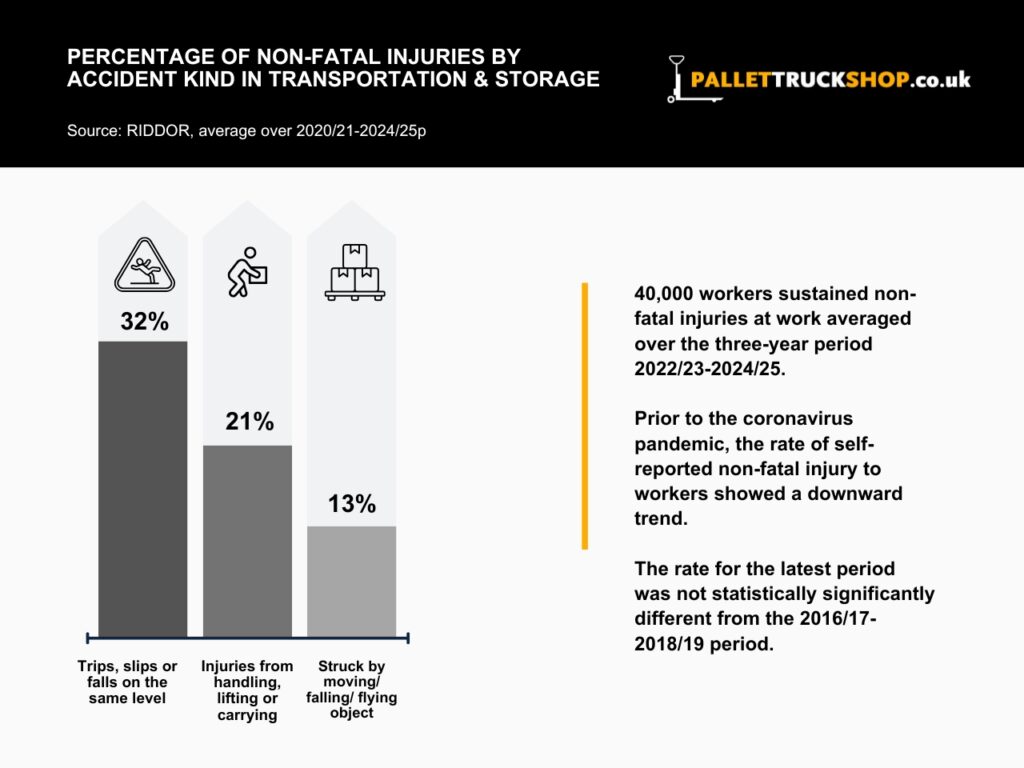
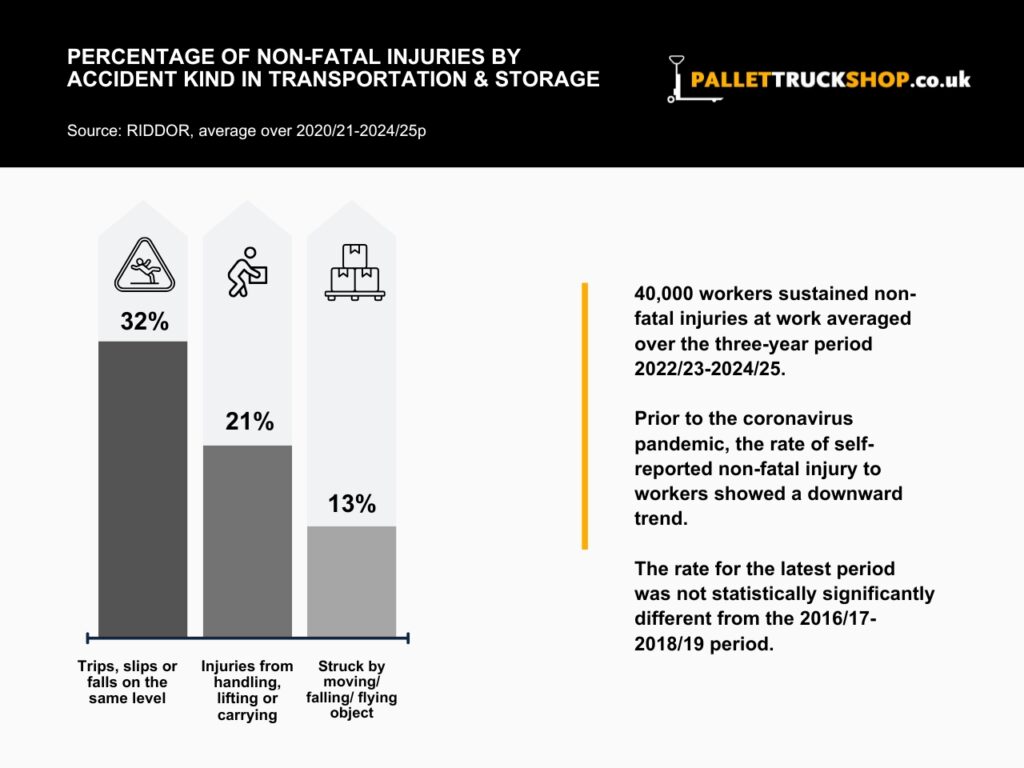
It starts off by setting the precedent: according to RIDDOR statistics – both historic and contemporary – the storage and transportation sector is one of the most dangerous industries in the UK, with 67,000 workers suffering from work-related ill health between 2022 and the 2024/25 period.
HSE posits that in concentrating health and safety efforts on the main causes of injury and ill health at your premises, you can greatly reduce such risks. They also underscore the value of involving the workforce and union/safety representatives in the process to identify problems more readily and achieve more robust, longer-term solutions.
Common Problem Areas
- Poor housekeeping leading to slips, trips and falls
- Inadequate communication between pedestrians and vehicle operators
- Insufficient lighting in aisles, loading docks or storage zones
- Unsafe storage practices that lead to falling objects or unstable loads
- Fatigue, poor ergonomics and repetitive work patterns that cause musculoskeletal issues
- Lack of routine inspection processes for equipment, racking and pallets
Remedial Action / Solutions
- Implement a documented, regularly reviewed risk assessment process for all tasks and zones
- Maintain clear walkways, good housekeeping and obstruction-free escape routes
- Ensure good lighting, floor markings and signage for pedestrian/vehicle separation
- Provide appropriate PPE and enforce its correct use
- Train staff at induction and at regular intervals, particularly on manual handling, equipment operation and emergency action
- Encourage a culture of reporting faults, near misses and damage immediately
- Establish a planned inspection and maintenance schedule for pallets, racking, vehicles and handling equipment (e.g., forklifts, electric lift tables or pallet trucks)
- Review workplace layout for ergonomic flow, reducing unnecessary movement or awkward lifting
Materials Handling
Materials handling constitutes some of the riskiest tasks in warehousing and storage, as workers regularly interact with heavy, awkward or fast-moving goods, often in busy environments with both vehicles and pedestrians traversing a limited area. The HSE recognise that effective control is foundational to preventing injuries and maintaining smooth operational flow.
Common Problem Areas
- Injuries from awkward or heavy loads
- Poor lifting posture, excessive weight, unstable packaging and repetitive handling all increase the risk of musculoskeletal disorders
- Falls from height, which may occur during stacking, retrieving items at height, or working on mezzanines, vehicles or elevated storage zones.
- Vehicle accidents (collision and crush hazards) due to a high interaction between pedestrians and FLTs, pallet trucks or other mechanical aids
- Approximately 27% of fatal injuries in storage/transport result from incidents involving moving or falling objects, including falling pallets, unstable loads, poorly wrapped goods or roll-away trolleys
Remedial Action / Solutions
- As per the law, reduce manual handling where reasonably practicable – i.e., use lift tables, conveyors, pallet trucks, stackers, and other aids to eliminate or minimise the need for physical lifting
- Carry out task-specific manual handling risk assessments and implement established methodologies, such as TILE or the MAC tool.
- Improve shift patterns and task rotation
- Reduce fatigue, cumulative strain and repetitive movement injuries by spreading demanding tasks across shifts
- Provide clear segregation between vehicles and pedestrians with marked walkways, barriers and controlled crossing points to reduce collision risks
- Ensure stable storage and secure wrapping of loads
- Implement controls for working from height as per the legislation: redesign tasks to lower working levels, install robust barriers to platforms and use the correct PPE
- Train staff in safe lifting techniques and equipment use, including regular refreshers
- Regularly inspect equipment, encourage routine maintenance and upgrade to the best pallet trucks and other materials handling equipment models
Storage
In connection with storage, the HSE outlines clear expectations for employers. This covers 4 key sub-sections of focus:
- Storage systems, such as pallets or static racking
- Automated storage and retrieval systems like carousels or traditional crane-in-aisle equipment
- Temperature-controlled storage
- Storage of packaged dangerous substances, including flammable, corrosive and toxic chemicals
Here, the guidance offers a mix of specialist advice for particular warehousing niches and generalised guidance that will apply to all premises. To give you an overview, here are the key learnings:
- Storage areas should be specifically designated and properly marked
- The layout of storage and handling zones should be ergonomic, logical and safe for both vehicles and pedestrians – consideration of surface gradients, awkwardly placed doors, and guardrails is a must
- Thought should be given to the orientation of pallets, particularly in premises with mixed racking systems
- Pallets should be loaded according to an established pattern for maximum stability, and care taken with shrink or stretch wrapping to further secure those loads
- Stacking should not exceed the safe 4:1 ratio between the stack height and the minimum depth/width of the pallet
- Employers should implement an effective system for pallet and racking inspection, including maintenance and damage reporting, by trained personnel (SEIRS-certified).
- Appropriate PPE should be worn
- Hazard analysis and risk assessments should be conducted at appropriate intervals, when new processes are introduced or when they are significantly changed
Why HSG76 Matters for Managers, Supervisors & Safety Reps
As the years go by, we at Pallet Truck Shop have seen the landscape of our industry morph and adapt to disruptions that just don’t stop coming. Automation has been in the picture for a long time, but has undergone significant leaps thanks to the AI bubble accelerating its growth. At the same time, storage facilities are experiencing newfound strain as e-commerce demand surges in the UK and globally. I need not remind you of the impact of COVID-19 on occupational health across all sectors, from retail to manufacturing.
With disruptions such as these becoming all the more common, it’s not difficult to conclude that uncertainty is the ‘new normal’. To weather this storm, managers, supervisors and safety reps have got to be more nimble, more agile, and resilient in their activities. By foregrounding operations in the guidance of HSG17, they can:
- Protect the workforce from preventable injuries
- Avoid invalidated insurance claims through negligence
- Side-step costly injury compensation claims and fines from HSE prosecution
- Improve workforce morale and cohesion
- Safeguard stock from avoidable damage
- Increase operational robustness, efficiency and business continuity
- Keep your reputation safe from legal repercussions and/or media fallout
The Bottom Line on Warehousing & Storage Safety
Now that we’ve come to the end of this refresher on the HSG76 guidance, you should feel more confident that your day-to-day operations are up to scratch. Or, at least, they will be with the appropriate remedial action.
By following the guidance laid out by HSE, you can take the steady journey of transforming tick box compliance exercises into a true culture of proactive care, enforced throughout your organisation at every level. Remember, accountability is key, so always strive for continual improvement and feedback from your team.
What’s the next step? If you haven’t already, acquire a copy of the manual and distribute it amongst your staff, keep track of training, and stay informed. Speaking of… our blog is full of manual handling insights and more – take a look if you’re eager to expand your knowledge or get in touch with our friendly team via email or on 01384-841430.
Disclaimer: The health and safety information provided in this guide reflects the present-day guidelines from the HSE and does not constitute legal advice.
Frequently Asked Questions
Is HSG76 Legally Binding?
While the Health & Safety Executive are certainly an authority on workplace compliance and hazard mitigation, the guidance laid out in HSG76 isn’t compulsory.
The document is intended as a digestible reference guide for professionals already aware of the legislation pertaining to warehouse health and safety, so they can instil best practices and train staff efficiently, rather than a rigid set of rules.
This said, HSE is always explicit in its documentation when referring to regulatory matters and sets a general standard for compliance.
What Does HSE’s Warehousing & Storage Safety Guidelines Cover?
HSG76 is an excellent starting point for warehouse staff seeking to brush up on their workplace health and safety responsibilities since it covers the A-Z of best practices. This includes manual handling risks and automation, mechanical handling, workplace transport, working from height, and more holistic procedures, such as electrical safety and accident/emergency protocol.
Is it a Legal Requirement to have Manual Handling Training?
Yes, it is an employer’s legal responsibility to ensure all staff are sufficiently trained as to reduce the risk of injury to themselves or others. This is a statutory requirement under the Manual Handling Operations Regulations 1992 and the Management of Health and Safety at Work Regulations 1999.
How Can I Stay HSE Compliant?
To abide by the law, employers and staff must follow the workplace regulations laid out by the government and adopt a proactive strategy for planning, implementing, monitoring and reviewing health and safety procedures.
An effective place to start is with a formal management system or framework, wherein a step-by-step methodology outlines how staff should respond to and control risks.
Regular external health & safety training or certification is another valuable option that helps workers crystallise learnings and stay on top of changing legislation. Here, I recommend looking at courses that are RoSPA and CPD approved.
Is there a shorter-form version of HSG76?
Yes, there is. If you’re looking for a brief, ‘glance and you ’re done’ resource to refresh your memory on injury reduction and minimising cases of occupational ill health, INDG412 is your first port of call. This 5-page guide is a helpful document to keep on hand for newer staff or those after a quick refresher on the job.