
Manual handling safety isn’t merely a hollow exercise of dotting the ‘I’s and crossing the ‘T’s; it’s a matter of operational efficiency, compliance and, above all else, workers rights.
No one deserves to feel unsafe in their workplace, yet manual handling remains a top cause of workplace absence, despite the buzz around automation and AI-driven innovation. Given that in the 2024/25 period, 680,000 workers sustained a non-fatal injury in the workplace, there’s plenty of room for improvement across all industries.
Hence the role of this guide: with this comprehensive explainer, you’ll gain insight into the practical techniques and best practices that keep staff safe, your legal responsibilities, and the tools recommended by the Health & Safety Executive to reduce the risk.
Skip ahead to:
- TL;DR
- What Activities Count as Manual Handling?
- Legal Responsibilities
- Common Hazards to Account for
- Safe Manual Handling Techniques
- The Role of Equipment & Technology
- Building Safer Working Habits
- Conclusion
- FAQs
TL;DR
Manual handling safety is vital to workplaces where tasks involving bodily force are commonplace. To reduce musculoskeletal injury, employers must implement the best practice techniques laid out in the Manual Handling Operations Regulations 1992 where avoidance isn’t reasonably practicable, assess risks and provide training.
What Activities Count as ‘Manual Handling’?
Manual handling simply refers to any activity involving bodily force: lifting, carrying, lowering, pushing, pulling, or supporting a load physically. In practice, this may look like…
- Construction workers moving building materials on-site
- Garden centre staff lifting compost into a customer’s trolley
- Healthcare staff moving patients from beds to wheelchairs, and vice versa
- Factory or warehouse workers moving inventory into storage
- Retail workers moving deliveries into the back room
Because these tasks put staff’s bodies on the line, they bear an implicit risk of injury, which is exactly why manual handling is subject to a handful of workplace safety legislation.
What Are Your Legal Responsibilities Around Manual Handling?
Numerous pieces of legislation underpin manual handling safety in the UK:
- The Manual Handling Operations Regulations (MHOR) 1992, which places the responsibility on employers to protect staff from “risk of injury and ill health from hazardous manual handling tasks in the workplace” by following the prescribed safe manual handling techniques.
- The Health and Safety at Work Act 1974 – an overarching framework for workplace health & safety, and public assurance, including risk assessment, incident reporting and controlling hazards.
- The Provision and Use of Work Equipment Regulations 1998 (PUWER) – a law requiring all employers to ensure the safety, suitability, regular inspection and maintenance of work equipment.
- The Lifting Operations and Lifting Equipment Regulations 1998, which cover the provision of safe lifting equipment (like cranes, hoists and different types of forklifts), their appropriate use and risk prevention through planning and record keeping.
Combined, they assert that employers must, so far as reasonably practicable, reduce the need for manual handling in the first place; provide adequate training and specific information about the loads in question (weight and centre of gravity); and make changes to the working environment to facilitate safer operations.
While employers bear the brunt of the legal responsibility, staff are obliged to use the information and resources given to them, be it a training course or documentation for incident/accident reporting.
Besides the clear impact on the physical and emotional well-being of those involved, incorrect manual handling techniques pose a serious risk of financial, reputational and operational damage to your organisation, on a sliding scale of severity. Often, this results in a formal warning from regulators, but in the worst-case scenario, the impact can be life-changing.
As Mark Cullen, Assistant Chief Executive of the Health and Safety Authority, said after an electrical engineering company was prosecuted in May 2025: “Where there is a risk of serious injury, employers must take appropriate measures to avoid the need for manual handling of heavy loads. As can be seen from this case, failure to do so can lead to tragic outcomes.”
The Most Common Manual Handling Hazards
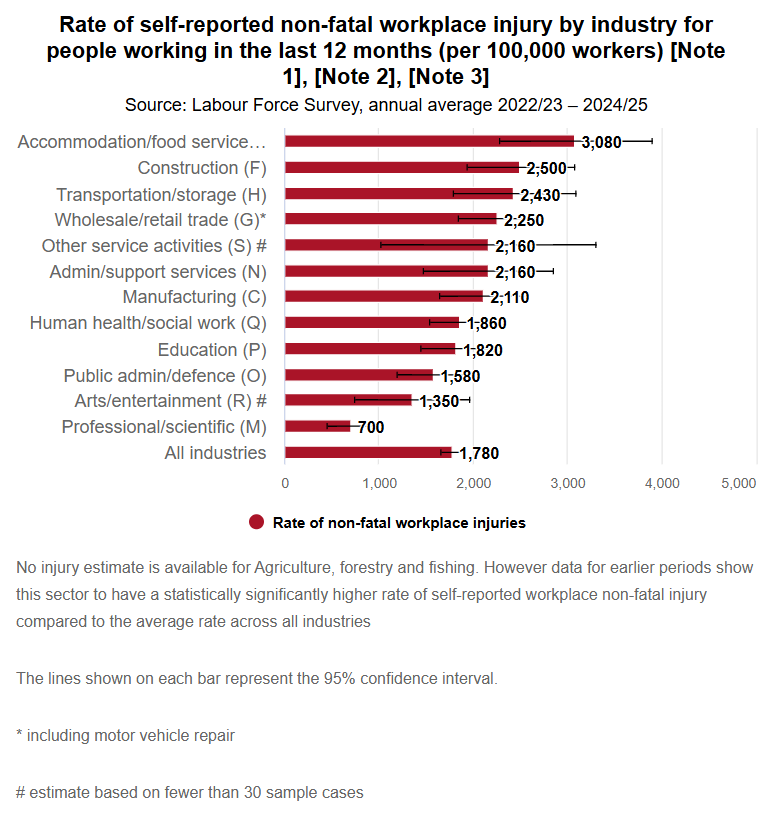
Hazards occur in practically all workplaces, but certain environments are more prone to risk because of the nature of daily operations, as demonstrated by the table of 2024-25 Labour Force Survey data. Nonetheless, all employers, from warehousing to healthcare, ought to be aware of the common hazards that pose a risk to themselves, colleagues, visitors and, of course, the general public.
- Overexertion: The human frame wasn’t built to withstand exceedingly heavy loads. As such, those undertaking the incorrect lifting, handling or carrying of objects at work are predisposed to potential health risks, particularly musculoskeletal injuries like sprains.
- Poor posture: Because manual handling tasks often put pressure on the back, joints and ligaments, incorrect posture aggravates the risk of injury, such as slipped discs, lumbar strain and ACL tears.
- Repetitive tasks: Performing repeated movements inherently carries the risk of repetitive strain injury, and is one of the most common reasons clients enquire with us at Pallet Truck Shop – looking for materials handling equipment that can automate these tasks and bring such injury risk down.
- Slips/trips during handling: One of the more serious hazards that employers should account for by making floor surfaces even, walkways well-marked and carrying distances as short as reasonably possible.
- Poor load stacking or storage: From stacking pallets to lifting inventory into warehouse racking, lifting up objects to store them doesn’t simply pose a risk of injury through lead-bearing activities, but also the items being insufficiently secured and falling onto a worker.
For a more comprehensive deep dive, make sure to read our dedicated guide to manual handling hazards and how to overcome them.

Safe Manual Handling Techniques That Work: What HSE Recommend
Now that you have an understanding of the risks and responsibilities that employers are charged with under MHOR, what does it say about safe manual handling techniques?
Modify Manual Handling You Can’t Avoid
If, even after eliminating superfluous manual handling activities, these physical tasks remain, you should aim to minimise the associated risk by tweaking the factors within your control.
For example, can you make the floor surface more even, or improve the quality of PPE available to your staff? If inventory arrives in awkwardly shaped packaging or in especially heavy loads, is it possible to ship them in smaller, more ergonomic packages?
Likewise, you may wish to alter the layout of your facility to reduce carry distances or avoid unnecessary floor traffic – the latter is worth serious consideration if the space is shared by vehicles and heavy equipment.
Always Assess Before Lifting
The golden rule of manual handling safety is never lifting blindly. Whether you’re engaged in potentially hazardous lifting, lowering, pushing, pulling or carrying, a risk assessment is crucial.
Preliminary checks can be made with the HSE’s risk filters as to whether a full assessment is required, but generally, it’s best practice for complex, repetitive, awkwardly shaped, heavy or team operations.
In a nutshell, this involves identifying the context-specific risks to the manual handling scenario in question, identifying who might be harmed, and actioning remedial changes to mitigate those risks. Crucially, this documentation should be shared with the relevant staff, safety reps and managers, and retained for future use and transparency.
Best-Practice Posture & Safe Techniques
Regardless of sector, it’s vital to safeguard the health of your employees and those who come into contact with them, be the latter an associate or a member of the general public. Here are a few quickfire pointers to reinforce your manual handling techniques.
Do:
- Assess the conditions of your surroundings before initiating the task; the floor surface should be dry, clean, firm, level and free of obstructions. It’s also a good idea to alert colleagues in your vicinity of what you’re about to do.
- Make sure you have a good grasp on the load, ideally using handles or handholds that allow either a comfortable power grip for pulling or full-hand contact for pushing.
- Lift the weight of objects with your legs, rather than your back, keeping your feet apart and grounded, and your centre of gravity low.
- Avoid twisting your torso or bending your back as you move any loads – think “bend knees, keep back straight, lift with legs” to prevent strain.
- Ask for help if you need it and encourage your colleagues to do the same; they may be able to provide instructions whilst you handle the load or help you carry the weight. Likewise, offer them support if you see them struggling.
- Avoid lifting heavy items from floor level if possible, or above shoulder height.
Don’t:
- Use equipment without a thorough understanding of the best practices for its use.
- Try to move an item that exceeds your individual capacity.
- Continue to handle a load if you’re experiencing pain or discomfort – your body is sending these signals for a reason.
- Ignore the information or legislation you’ve been provided; it’s there to keep everyone safe, however much hassle it feels in the moment.
- Attempt to move loads over long distances or complete repetitive tasks without sufficient rest breaks.
- Move too fast or in sudden, jerky movements – slow, smooth and steady is always best, so aim for small, controlled steps.
Knowing When to Ask for Help
Finally, if you or a colleague is struggling with a particular task, never attempt to push through it without additional support. Here, it is always best to redesign the task, enlist the help of another capable staff member, or postpone the task until the right equipment is available, as rushing the operation is where accidents happen. As they say, many hands make lighter work.
Fortify Your Manual Handling Operations with the Right Equipment
Going back to the HSE guidance, not every task needs to be done manually – far from it. In fact, in pressurised situations and during industry surges (think: the Christmas rush for distribution centres), looking towards reliable, ergonomic tools is the natural alternative.
With more than 30 years of experience supplying pallet trucks, stackers, table trucks and other critical handling aids, I can attest that the right equipment really does make all the difference. With the cumbersome grunt work transferred to the best pallet trucks on the market, our customers have often reported back about cut operational costs, reduced downtime and, most importantly, an uptake in employee satisfaction.
To make such equipment work harder for your business, I also recommend conducting detailed research into which sorts of equipment are compatible with your site layout and load types. For instance, construction sites would benefit from a rough terrain pallet truck, whilst a small retail stockroom may only accommodate a mini pallet truck.
Going Beyond Compliance to Build Safer Work Habits
Manual handling safety is just as much about fostering a culture of care as it is about recording incidents and learning from them as and when they do happen. Instead, workplaces should go the extra mile to instil prevention and harm reduction across every aspect of the business, which means being proactive rather than reactive.
In practice, this might look like strengthening relationships with health and safety reps, making procedures and checklists more readily available, and ensuring the workforce is kept up to date on evolving policy through regular refresher training or toolbox talks. More broadly, employers should make the effort to create a near-miss reporting system, so the team is constantly improving, even when on the face of it, operations are ticking along.
Conclusion: Safety Is a Shared Responsibility
Ultimately, health and safety is a shared responsibility, between site owners and employers, staff and their union representatives. As such, organisations mustn’t solely rely on a bottom-down chain of command.
By fostering a culture of accountability, wherein staff are empowered to assess risks unprompted, share their learnings and feel confident using the correct tools, you create both stronger morale and more efficient operations. Which brings you to an important choice: will your organisation continue to do it manually, or is it within your means to upgrade the handling process?
If so, the first step is to find the right manual handling equipment for your operations. Here, our industry specialists are more than happy to discuss your requirements on 01384-841400 and help you find a good fit. In the meantime, though, it’s a good idea to brush up on the official manual handling guidance or perhaps even enrol on a refresher course – there’s always something to learn.
FAQs
What Should Employees Be Expected to Reasonably Lift?
There are no legal limits attached to specific load weights, but the regulations require a risk assessment that considers the mass alongside task specifics, such as working environment, individual capability, type of movement required and the impact of PPE on posture.
If in doubt, HSE provides a lifting and lowering risk filter, which uses broad assumptions or generalisations to help staff determine manual handling safety for a given task.
Do I Need to Conduct a Risk Assessment for Every Manual Handling Task?
Low-risk tasks, such as carrying a small box of paperwork, don’t need formal assessment, although they may benefit from being run through HSE’s simple filters to double-check if you are uncertain. More hazardous tasks involving more complex risk factors, such as a higher weight, longer carry distance or ungainly load shape, require a full manual handling risk assessment.
How Can I Reduce the Risk of Injury from Manual Handling Activities?
The first step is to reduce all manual handling tasks so far as is reasonably practicable, but if it is impossible to eliminate physical handling completely, employers can also: reduce carry distances, improve the shape and size of loads, improve facility conditions like lighting and flooring, improve training, and offer manual handling aids such as pallet trucks.
What is the Safest Manual Handling Technique for Lifting?
The safest manual handling techniques follow HSE best practices. This involves assessing the load before moving it, getting close to the object, and adopting a stable stance with feet apart.
When lifting items from the ground, your body should bend at the knees whilst your back remains straight, lifting with your legs and moving with your feet rather than twisting.
This “lift with your legs” approach, using leg strength, minimises spinal strain and risk of injury, with the golden rule being to keep the load near your centre of gravity.
What are the Best Resources for Continuing My Learning?
As the UK’s official workplace regulator, you can rest assured that its resources and documentation meet current regulatory standards. I’d recommend starting with the HSE’s official guidebook, INDG143 – Manual Handling At Work, which covers all of the basics in short form.
Once you’ve familiarised yourself with the guidance there, I also recommend looking at the Manual Handling Assessment Charts tool (MAC), TILEO framework, and the pushing/pulling risk assessment tool, RAPP. Each of the trio provides detailed information on how to assess and approach different types of manual handling tasks.