
The release of the last Labour Force Survey from Health and Safety England paints a sobering portrait of Britain’s workplace safety: between 2024 and 2025, one hundred and twenty-four worker fatalities and an estimated 680,000 non-fatal injuries were recorded, 17% of the latter due to a manual handling accident. It’s undisputable, then, that manual handling techniques and best practices should be among employers’ top priorities for 2026.
No matter your workplace or industry, if materials handling is a commonplace activity, everyone involved needs to know how to do it safely and prevent the associated risks. Which is exactly what this guide is all about.
Shortly, I’m going to draw on more than 30 years in the materials handling space to give you a run-down of the manual lifting, pushing and pulling proceduresrecommended by HSE, where employers stand in terms of compliance, and how to make light work of heavy loads using the proper equipment.
Skip to:
- What Manual Handling Means in the Workplace
- Why Standardised Manual Handling Practices Matter
- The Most Common Types of Manual Handling Tasks & How to Approach Them
- Reducing Strain with Equipment and Task Modification
- Conclusion: Your Next Steps for Improving Manual Handling Safety
- FAQs
TL;DR
Manual handling techniques should follow HSE best practices and structured frameworks like TILE to reduce the risk of musculoskeletal injuries. Employers can further lower strain by modifying tasks and introducing manual handling equipment, such as pallet trucks, to improve workflows, safety and efficiency.
What Manual Handling Actually Means in the Workplace
Manual handling is a misunderstood beast. It typically conjures up images of bustling warehouses, construction workers hauling building materials, and NHS staff manoeuvring patients from bed to stretcher, even baggage handlers in airports, but the prevalence of these physically demanding activities is much broader than many people realise.
Indeed, manual handling refers to any activity that requires bodily force: lifting, lowering, pushing, pulling, carrying, or supporting a load physically, whether a one-time task or a repeated one. This means manual handling takes place in nearly every business, not just in labour-intensive or industrial settings (e.g., manufacturing, agriculture or distribution).
Nevertheless, many employers tend to overlook the risks associated with manual handling in their daily operations. An oversight that may well contribute to approximately one-third of all reported workplace injuries being linked to poor manual handling, as many hazardous tasks remain unrecognised until after an injury occurs.
Why Standardised Manual Handling Practices Matter
Although, in some cases, manual handling injuries will be minor, no uncontrolled level of risk is tolerable – in the context of regulatory compliance, but also on a human level, as no one deserves to be put in unnecessary danger at work. Instead, health and safety should be baked into the culture.
As Sheila Flavell, COO of FDM Group, noted after British Airways was fined more than £3m after two such incidents: “HR teams need to weave safety awareness into the entire employee lifecycle, from day one to leadership development. That includes scenario-based learning, regular check-ins, and giving managers the confidence to spot and address risks early.”
Beyond the negative, a proper understanding of manual handling and its best practices leads to happier and healthier employees, and on a larger scale, a flourishing economy. After all, when workplaces are safer, they also run more smoothly, with fewer interruptions, expensive delays or unwanted surprises.

The Most Common Types of Manual Handling Tasks & How to Approach Them Safely
While a broad-brush term, there are a handful of established manual handling techniques recommended by HSE, which have been specifically designed by experts to comply with The Manual Handling Operations Regulations 1992 (or MHOR).
These manual lifting, pulling and pushing procedures help negate the impact of:
- Heavy work;
- Awkward postures;
- Exacerbating existing injuries or conditions;
- And repetitive movements that could cause strains.
An Overarching Approach: Avoid, Assess, Reduce
Before drilling into specific manual handling techniques, it’s important to understand the hierarchy that underpins UK best practice. As an employer, the following approach should be instilled into every employee expected to undertake manual handling tasks.
- Avoid: Where reasonably practicable, hazardous manual handling should be avoided altogether. This may involve redesigning workflows, reconfiguring storage systems, or introducing automation to remove the need for manual lifting entirely.
- Assess: If you’re in a situation where manual handling is unavoidable, the risks must be assessed. This is where structured frameworks such as TILE (Task, Individual, Load, Environment) come into play. Here, your assessment should consider the weight and shape of the load, the frequency of movement, the working environment, and the capability of the person undertaking the task, among other factors.
- Reduce: Once those risks are identified, employers must take tangible steps to reduce them. This may involve training staff in correct lifting technique and other manual handling procedures, modifying the task, reducing load weights, or introducing equipment to minimise strain.
TILEE, or Task, Individual, Load, Environment, Equipment
One of the most widely used manual handling frameworks in the UK is TILE, and it comes highly recommended from HSE. Do note that you should run through the process for each individual handling task in question, and update your records each time the task is modified.
- Task: What does the job involve? Is it repetitive, awkward, rushed or physically demanding? How do these specifics influence the job?
- Individual: Does the person have the capability, training and physical ability to perform the task safely? For instance, do they have a medical condition, disability or existing injury that needs to be accommodated?
- Load: Is it heavy, unstable, difficult to grip or unevenly weighted? Think about its centre of gravity and where staff may struggle. These can pose a serious risk if left unaddressed.
- Environment: Are there space constraints, uneven flooring, poor lighting or temperature extremes to consider?
Some organisations expand this to TILEE, adding…
- Equipment: Are suitable mechanical aids available, and are they being used correctly? Plus, have they been well-maintained? What is their condition?
Applying TILEE systematically ensures that your moving and handling techniques are appropriate to the situation, rather than relying on assumption or habit.
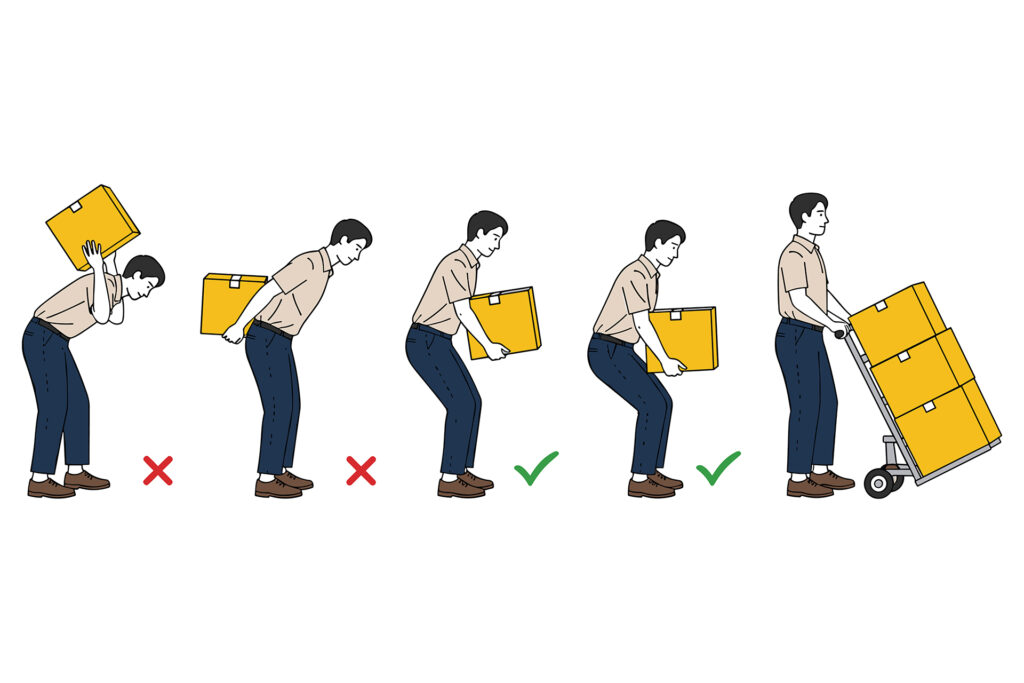
Correct Lifting Techniques
When lifting cannot be avoided, a safe manual lifting procedure should be followed consistently across the workforce. While correct lifting technique manual handling guidance cannot remove risk entirely, it significantly reduces strain when applied properly and supported by risk assessment.
The HSE-recommended steps for lifting include:
- Planning the lift: Before touching the load, assess its weight, shape and stability. Consider where it is being moved to, whether the route is clear, and if doors, steps or uneven flooring could present additional hazards. Planning also means asking whether the lift should happen at all, or whether equipment or assistance would be safer.
- Position your feet: Place your feet shoulder-width apart to create a stable base. One foot should be slightly forward to maintain balance and allow a smooth forward movement. Proper foot positioning reduces the likelihood of overreaching or losing balance mid-lift, both of which significantly increase injury risk.
- Adopt a stable posture: You should bend at the hips and knees rather than the waist, keeping the back in a natural, neutral alignment. This allows the most powerful muscles in the legs to take the strain rather than the smaller muscles in the lower back. Avoid crouching too deeply or rounding the shoulders, as this can compromise stability and increase strain on the spine.
- Keep the load close: Holding a load away from the body dramatically increases pressure on the spine due to leverage forces. Wherever possible, keep the load close to your torso, with elbows tucked in. If an object cannot be held close, this may indicate that the task requires redesign or mechanical assistance.
- Maintain a neutral spine: The spine should remain in its natural ‘S’ shape throughout the lift – avoiding arching or rounding forward. Engaging the core muscles will help you distribute the force evenly.
- Lift smoothly: Avoid sudden jerking or rapid movements. Controlled, steady lifting is what you want, since it reduces the pressure on your muscles and joints whilst keeping you nice and balanced.
- Avoid twisting while lifting: Twisting under load is a common cause of lower back injuries. If your direction needs to change, move the feet rather than rotating the torso. If you have planned the lift and positioning correctly at the start helps you won’t need to worry about mid-lift adjustments.
Case Study Example
Imagine a regional warehouse where staff regularly lift boxed goods from floor-level pallets to shelving. Over time, several employees report mild lower back strain; not from a single accident, but from repeated poor lifting techniques and frequent twisting under load.
After reviewing their manual handling techniques using the TILE framework, managers identify that high-volume items are stored too low and staff often carry loads further than necessary. By repositioning stock at waist height, reinforcing the correct manual lifting procedure through refresher training, and reducing carrying distances with pallet trucks, strain risk is massively lowered. All in all, the warehouse safety is improved.
Safe Pushing & Pulling Methods
Many employers assume lifting presents the greatest danger, but pushing and pulling activities are responsible for a significant number of musculoskeletal injuries. Without proper management of posture, it’s easy to twist in such a way that increases the risk of sprains or slipped discs, and dropping a heavy item poses the danger of it hitting another worker below. (For more about working from heights, see our previous guide.)
Best-practice moving and handling techniques for pushing and pulling include:
- Keeping hands between waist and shoulder height where possible
- Maintaining a straight back and engaged core
- Using body weight to initiate movement rather than arm strength alone
- Avoiding overreaching or sudden force
- Ensuring wheels, castors and floor surfaces are well maintained
Where loads are mounted on wheeled equipment, such as pallet jacks or sack trucks, the force required can be significantly reduced, and even more so when the equipment is suited to the environment and properly maintained.
Case Study Example
Consider a busy garden centre where staff regularly push heavy plant trolleys across gravel pathways. While lifting is minimal, employees begin reporting shoulder and upper-back discomfort caused by excessive force and awkward posture during these repeated tasks.
A review of their moving and handling techniques might reveal uneven surfaces increasing resistance, and staff pushing with extended arms rather than using their body weight. By resurfacing key walkways, maintaining trolley wheels properly, or even replacing them with a pallet truck more suited to rough terrains, and, of course, retraining staff on safer pushing posture, strain levels can be significantly reduced.
Team Handling and Awkward Loads
Some tasks fall outside safe individual capability, even with correct manual handling techniques. These include:
- Long or unstable items
- Loads that obstruct vision
- Irregular or shifting weight
- Large, bulky goods
In such cases, team handling may be appropriate, but only where:
- One person is clearly designated to coordinate the lift
- The load weight is evenly distributed
- All parties understand the manual lifting procedure before beginning
- Clear communication is maintained throughout the manoeuvre
However, team handling is not always the safest solution, as you might realise after completing your risk assessment. If coordination is poor or visibility restricted, the risk may increase rather than decrease. In many cases, mechanical assistance remains the safer and more controlled option.
Reducing Strain with Equipment and Task Modification
As the HSE makes clear, good manual handling techniques should never be treated as a substitute for eliminating or reducing risk at the source. Even where staff are well trained and physically capable, certain loads remain inherently hazardous due to their weight, size, shape or frequency of movement.
Where manual handling risks cannot be avoided, employers should first consider modifying the task itself: for example, reducing the load weight, adjusting storage heights, improving layout flow, or minimising carrying distances. However, when task redesign alone is insufficient, the most practical and cost-effective solution is often the introduction of suitable mechanical aids, such as pallet trucks, various types of forklifts, stackers or table trucks.
With three decades of experience in that area, I can attest that proactive equipment planning is often more economical than responding to injury-related disruption or adapting your environment alone. Whether the pre-peak preparation window or the height of the Christmas rush, warehouses in particular can keep downtimes low, without compromising on worker safety or overall productivity.
Conclusion: Your Next Steps for Improving Manual Handling Safety
It may be a cliché, but it’s for good reason: refining your policy around manual handling and settling on organisational-wide best practices isn’t a tick box exercise, nor are the motivations solely financial. When the health and well-being of your employees ride on prescribed techniques, businesses must pull through and do their bit to make the workplace a safer place to be.
And if you’re unsure where to start, allow me to point you towards our manual handling risk assessment guide. With it, you can reactivate your knowledge whilst refreshing staff training and reviewing high-risk tasks within your operations. Once you have that all sussed out, consider gaps in the protocol where mechanical aids could alleviate undue strain; whether a purchase is just around the corner or further on the horizon, being prepared pays dividends.
Does your equipment match operational demand? If not, our friendly customer service team would be delighted to discuss your materials handling needs on 013384-841400.
Frequently Asked Questions
What are the 5 Key Principles of Safe Manual Handling Techniques?
In the materials handling sector, it is broadly agreed that there are 5 key principles of manual handling: plan, position, pick, proceed and place. These focus on assessing the load, positioning the feet correctly, bending the knees (not the back), keeping the load close to the body, and avoiding twisting throughout the process.
In the UK, the HSE have their own 5-step framework, TILEE (Task, Individual, Load, Environment, Equipment), which functions as a shorthand for your manual handling risk assessment.
What are the Most Common Manual Handling Methods & Frameworks?
The most common manual handling methods include lifting and lowering, pushing and pulling, carrying, team handling, and repetitive handling tasks. To manage these safely, employers ought to use structured frameworks such as the TILE or RAPP risk assessment model, the Manual Handling Assessment Charts tool (MAC), and HSE-recommended safe lifting techniques.
What is the Employer’s Legal Responsibility for Manual Handling Safety?
According to HSE’s official guidance and under The Manual Handling Operations Regulations (MHOR) 1992, employers have a duty of care to reduce the risk of injury wherever ‘reasonably practicable’.
In action, this means avoiding unnecessary strenuous tasks, but where they can’t be avoided, conducting a dynamic risk assessment and implementing suitable control measures, from task modification to supplying training and/or equipment.
When Should Mechanical Aids be Used Instead of Manual Handling?
Employers should facilitate smoother, more streamlined and, ultimately, safer manual handling wherever possible – and that involves supplying appropriate materials handling equipment. Mechanical aids such as pallet trucks, aerial work platforms or stackers should be used when loads are heavy, bulky, repetitive, or awkward to grip; essentially, in any instance where the risk is increased.
Is Pushing or Pulling Safer than Lifting?
It can be, provided the individual or individuals undertaking the task are using appropriate handling techniques and well-maintained equipment, and that the weight doesn’t exceed their maximum capability. That said, poor posture, excessive force, or uneven surfaces can still create significant risk if not properly managed.
How Can Small Businesses Improve Manual Handling Safety Without Major Investment?
Small businesses can improve safety by reviewing task design, rethinking workspace layouts, adjusting storage heights, improving housekeeping, and reinforcing correct handling techniques through in-house training.
If budget spend isn’t completely off the table, you may wish to introduce a couple of cost-effective aids, such as manual pallet trucks – the best models will significantly reduce strain without the need for large capital investment.