
The construction sector is the beating heart of the British economy, ensuring investment for vital infrastructural projects, business and civic regeneration, neighbourhoods and homes are well-spent. Though health and safety standards are broadly improving, it also remains one of the most dangerous industries for workers, making safe manual handling in construction an imperative for real estate developers, general contractors, specialists and engineers alike.
Over the 3-year period 2022/23-2024/25, non-fatal injuries at work averaged out at 50,000 reported incidents. And, tellingly, 53% of work-related ill health was recorded as musculoskeletal disorders according to Health and Safety Executive (HSE) data. The signs are clear: despite the industry’s best efforts and regulator intervention, there is still a long way to go.
Continual education and refresher training are but one aspect, yet it is an important one. Hence the purpose of this guide: to refresh managers, safety reps and on-site staff on the duties and dangers that come along with materials handling tasks, so they can be better prepared.
Let’s get started.
Contents:
- TLDR
- A Quick Recap on Manual Handling
- Potential Risks Site Managers & Construction Workers Need to Know
- Manual Handling Under Law
- The Assess, Control and Review Model
- Conclusion: Manual Handling in Construction Beyond Reactivity
- FAQs
TLDR
Manual handling in construction includes lifting, lowering, carrying, pushing or pulling loads using bodily force, and poor practices can lead to injuries and other serious incidents. Employers should avoid hazardous manual handling where reasonably practicable and assess, control and regularly review unavoidable risks through safer working methods, suitable equipment, training and effective site management.
A Quick Recap on Manual Handling
Manual handling can occur in any workplace, office to hospital, factory to retail stockroom. However, physically demanding jobs, which necessitate the transportation of heavy materials, tools and machinery, are prone to more frequent manual handling tasks, including those more complex, riskier manoeuvres.
But before we get into that, allow me to walk things back to the basics. After all, these fundamentals are the basis for robust health and safety across the board.
What Constitutes Manual Handling?
Manual handling is simple to get your head around; it simply refers to tasks that involve the physical transportation of loads via bodily force. This includes lifting, lowering, carrying, pushing and pulling, even using a mechanical aid such as a pallet truck.
These types of activities are governed by the Manual Handling Operations Regulations 1992, meaning that how, why, where, when and by who matters a great deal.
Where Might it Occur in Construction Settings? 6 Examples
To give you a clearer picture of exactly how a manual handling task may play out on a building site, here is a brief set of examples of when they might be required in the construction industry.
- Carrying building materials, such as bricks or bags of cement, by hand or in crates
- Helping lower different types of palletised goods from a tail lift (e.g., bulk bags of gravel or wholesale order of bricks)
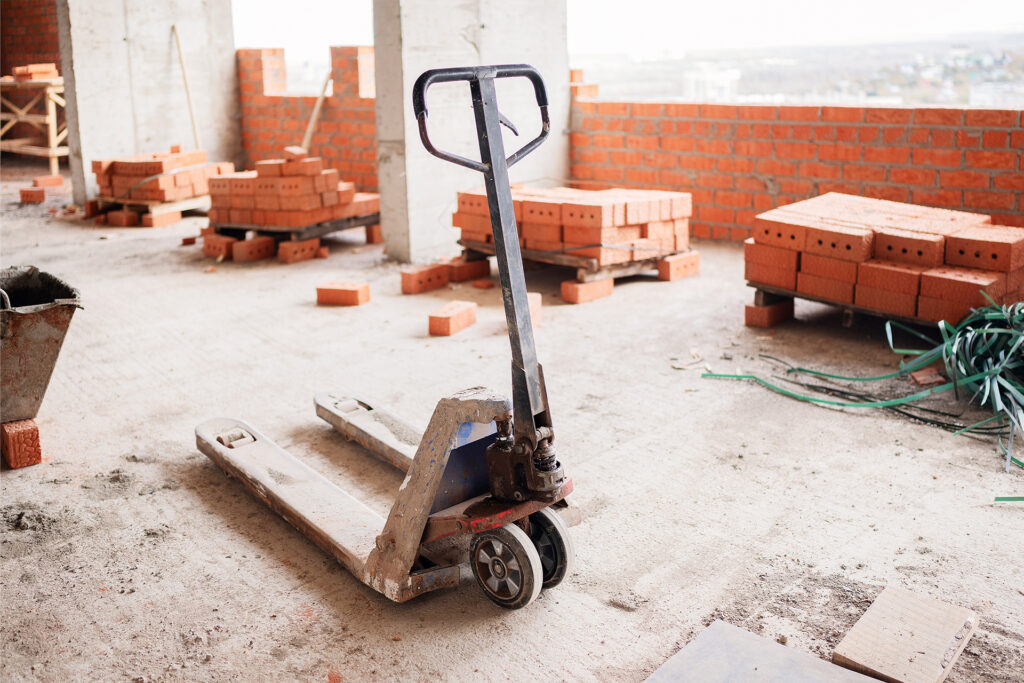
- Moving pallets around the site using a pallet truck or stacking pallets for storage
- Pushing full wheelbarrows or trolleys
- Lowering heavy tools into excavated areas or carrying them up a scaffold structure
- Installing cladding panels, windows or plasterboard
- Supporting the loading of vehicles so materials, tools and hardware can be transported around the site.
Of course, that is just the tip of the iceberg, so do be aware that any load – regardless of proportions, weight, contents or packaging – moved with bodily force falls under the scrutiny of the law and thereby must be properly handled.
Potential Risks Site Managers & Construction Workers Need to Know
Working in construction means putting your body on the line. As this pertains to manual handling, there is a slew of risks staff must be informed about and trained to mitigate.
Commonplace risks and hazards:
- Unsafe lifting technique
- Incapable, untrained staff moving loads
- Twisting or bending the spine during manoeuvres
- Manual handling whilst injured
- Working in cramped or awkward positions
- Rushing the task or skipping correct lifting form
- Individuals lifting more weight than they can safely bear (men 25kg, women 16kg)
- Subpar communication between staff
- Improper equipment use
- Exceeding equipment weight limits
- Failing to conduct pre-use checks
- Poor maintenance or outdated equipment
- Poor working environment
- Stacking pallets or conducting other manual tasks on unstable ground
- Slippery conditions
- Poor visibility
- Failing to account for obstacles and vehicles in use at the time
Resultant hazards:
- Temporary or permanent musculoskeletal disorder (MSD)
- Slips, trips and falls
- Collisions with other staff, loads or vehicles
- Crushes from dropping heavy loads, being trapped in equipment or loads sliding/falling
- Chronic pain
- Work-related stress
- Temporary incapacitation or long-term disability
- In the worst possible scenario, fatalities.
As the HSE reports, each year, 200,000+ Brits suffer from work-related back pain, and of these victims, the majority belong to the construction sector due to the manual nature of the job: repetitive movements, strained posture, working with heavy loads and, often, at height.
Each of these factors puts added strain on the body and increases the likelihood of injury over time, particularly if a worker falls under a more vulnerable category, such as being older or pregnant.
Manual Handling Under Law
Manual handling activities fall under the remit of several laws beyond the Manual Handling Regulations I mentioned earlier.
They are also subject to the:
- Health and Safety at Work Act 1974, which requires employers and staff to, so far as reasonably practicable, protect the health, safety and wellbeing of those under their care, including the general public.
- 2005 Working At Height Regulations, if manoeuvres take place above ground level “where, if there were no precautions in place, a person could fall a distance liable to cause personal injury”.
- Provision and Use of Work Equipment Regulations 1998 (PUWER), when work equipment and machinery are used, to ensure proper use, inspection and maintenance.
To guarantee you follow them to the letter, I’ve conveniently laid out your top-line requirements as recommended by the HSE.
Employer’s Responsibilities
The legislation places liability for accidents, injury, damages and death upon the employer, as it is their responsibility to ensure that manual handling is carried out in a safe and controlled manner, with all the risks accounted for.
This extends from employed staff and hired contractors to the realm of public assurance, particularly in public settings, like a building development in the heart of a housing estate or city centre.
On-the-Ground Staff Duties
The regs equally encompass employee responsibilities. Here, it is their duty to ensure that their actions don’t negatively impact others, from colleagues to site visitors. This means fully utilising the resources and knowledge supplied by their organisation and committing to proactive, careful decision-making on the job, including seeking assistance from a senior member of staff where necessary.
HSE Enforcement & Penalties
The PR consequences of employer negligence and malpractice speak for themselves, as does the unthinkable possibility of a serious injury, but what about the particulars of enforcement?
Well, since manual handling infractions constitute criminal rather than civil matters, the penalties can be steep. The HSE has the power to issue improvement and prohibition notices and fine non-compliant businesses substantially; there are no upper limits on cases that reach the Crown Court. In such serious incidents, employers may be prosecuted while the company is added to the HSE Breach List.
Top-Line Requirements
UK law sets out that employers must avoid (“as reasonably practicable”), assess and mitigate the risks associated with manual handling through task modification, training, environmental improvements and the provision of manual handling aids.
Fortunately, the whole process is made simple thanks to the clear safety hierarchy British regulators recommend. In practice, it’s something of a checklist that your organisation can swiftly adopt. Here’s what it looks like:
The Assess, Control and Review Model
To manage construction health and safety risks, HSE urge staff and employers to follow the Assess Control and Review model. It essentially guides your risk assessment process, preventing any critical factors from being forgotten.
Assess
First, identify and assess the task at hand:
- Who is completing the task? Evaluate their competencies for the job and how they might impact the outcome, allowing extra consideration for anyone who is known to have an existing problem.
- What are they doing? Sift through the particulars of the job, pinpointing any attributes that give rise to risk of injury or accident and consider how you can mitigate them. This ought to include constraints to proper lifting form, load stability, grasps, recovery times, job demands and time pressure.
- Where is the task being completed? Think about how the environment might contribute towards poor posture, obstructions, slips, trips and falls. Of course, ensure that individuals involved have been provided with appropriate PPE.
To identify higher risks, utilise The Manual Handling Assessment Chart (MAC) tool, which has been developed specifically for this purpose. Likewise, you can lean on the RAPP tool (for pushing and pulling) or ART tool (for repetitive tasks of the upper limbs) to cover all bases.
Control
With the proper insight, you may now enact your plans:
- Prevent risks before any work starts.
- Introduce mechanical lifting and carrying aids, such as telehandlers, forklifts, electric pallet trucks, dollies, hoists, etc.
- Deliver materials directly to their point of use.
- Make loads smaller and easier to handle.
- Rethink construction methods.
- Avoid mixing on site where possible; premixed options mean fewer loads to transport.
- Keep materials dry to prevent weight gain upon rainfall.
- Control any outstanding risks, including the environment, equipment upkeep, work practices and shift patterns.
- Train workers so they can competently navigate potential hazards and react to changing circumstances accordingly, whilst maintaining optimal form.
Review
Reflect, iterate and improve upon your processes to tighten up your health and safety further:
- Supervise workers throughout the manoeuvre to ensure controls are being effectively and properly maintained.
- Maintain your controls for future tasks and look after equipment sufficiently.
- Monitor performance and procedures over time, across sites and digitally, so records are available as and when needed.
- Act when you see any issues to put problems right before they snowball into a more serious hazard.
Conclusion: Manual Handling in Construction Beyond Reactivity
Manual handling in construction demands more than mere reactivity. This is not to say that agility isn’t a valuable asset; however, preceding swift responses to hazards, accidents and changing circumstances is a bedrock of company-wide awareness, confidence, deep skillsets and a tendency towards proactive care.
Because with compassionate, trusting teams comes happier, healthier workers and significant productivity gains. So, if there’s anything you do beyond the to-the-letter rule following, make it strengthening your institutional culture for the long haul.
In the meantime, though, if you require equipment upgrades, please get in touch with the Pallet Truck Shop team. We’ll happily advise you on the right solution for your precise circumstances.
Frequently Asked Questions
What Is Manual Handling in Construction?
Manual handling in construction is the transporting or supporting of a load using bodily force. It includes lifting, lowering, carrying, pushing and pulling materials, tools or equipment. It can also include moving loads with handling aids such as pallet trucks.
When Is Manual Handling Required in the Construction Industry?
Manual handling may be required when carrying building materials, moving palletised goods, pushing wheelbarrows or trolleys, transporting tools, installing items such as plasterboard or cladding, and loading or unloading vehicles. Any construction activity that requires a person to physically move or support a load can constitute manual handling.
What Are the Main Manual Handling Hazards on a Construction Site?
Common manual handling hazards include poor lifting technique, loads that are difficult to handle, twisting or bending during a task, repetitive movements, unsuitable or poorly maintained equipment, unstable or slippery ground, restricted spaces, poor visibility and nearby obstacles or vehicles.
What Injuries Can Manual Handling Cause in Construction?
Poorly managed manual handling can contribute to musculoskeletal disorders (MSDs), back pain, strains, slips, trips and falls. More serious incidents can involve collisions, crush injuries, long-term disability and, in the most severe circumstances, fatalities.
What Manual Handling Legislation Applies to Construction?
Manual handling activities are principally governed by the Manual Handling Operations Regulations 1992. Depending on the task, other relevant legislation can include the Health and Safety at Work etc. Act 1974, the Work at Height Regulations 2005 and the Provision and Use of Work Equipment Regulations 1998 (PUWER).
What Are an Employer’s Responsibilities for Manual Handling?
Employers should avoid hazardous manual handling operations where reasonably practicable. Where manual handling cannot be avoided, they should assess the risk of injury and take appropriate steps to reduce that risk. Measures can include changing the task, improving the working environment, providing suitable handling equipment and ensuring workers receive appropriate training.
How Can Manual Handling Risks Be Reduced on Construction Sites?
Risks can be reduced by eliminating unnecessary manual handling, using mechanical aids such as forklifts, telehandlers, hoists or pallet trucks, delivering materials closer to their point of use, reducing load sizes and improving working methods. Employers should also maintain equipment, train workers and continually monitor whether existing controls remain effective.
What Is the HSE Assess, Control and Review Approach?
Assess, Control and Review is a practical approach to managing workplace health and safety risks. First, assess the worker, task and working environment to identify hazards. Next, introduce measures that eliminate or control those risks. Finally, review the controls through supervision, maintenance and ongoing monitoring to ensure they continue to work effectively.
What Tools Can Be Used to Assess Manual Handling Risks?
The HSE provides assessment tools for different types of manual handling activity. These include the Manual Handling Assessment Charts (MAC) tool, the Risk Assessment of Pushing and Pulling (RAPP) tool and the Assessment of Repetitive Tasks (ART) tool.
Can Pallet Trucks Reduce Manual Handling Risks in Construction?
Pallet trucks can reduce the need to carry suitable palletised loads by hand, but using one can still involve manual handling, particularly when the operator pushes or pulls the equipment. The truck should therefore be suitable for the task and load, properly maintained and used by competent workers as part of an appropriate risk-control system.